Oh my god.
Yup that's me in the center, between Erik and Martin Demaine (Erik's dad), two of the best origami theorists in the world.
What happened? 5OSME happened! I'll be posting on what happened during the
conference part of of 5OSME, which just ended today.
Day 0: Tuesday, 13 July, SMU School of Business, Level 2
2-5 pm was exhibition setup for the exhibitors then an evening reception for all conference registrants. There were many glass cabinets for the various exhibits, some along the corridors and others in rooms. I went over to set up my exhibits in these tall glass cabinets. You can see some of my exhibits in these photo:
That's Nikhil squatting down to arrange his own exhibits and Darrel Tan and Michael Ang respectively. Yuan Chen Yang is standing behind Michael. I'd made a presentation to the whole school to persuade the students to join 5OSME and the school to subsidize their fees, and I sort of succeeded; Michael and Chen Yang are attending the conference, and about 20 other NUS High students will be attending the convention tomorrow.
My exhibits are on the 1st and 3rd compartments from the top in the cabinet in front of Nikhil. They include the "Prosperity" model (that has been re-christened "Fortune"), "Honeycomb", "House" and "House on a Turtle" that have appeared in previous posts. I've taken more detailed photos of the new ones:
A House grafted onto John Montroll's Hermit Crab from "Origami Sea Life". Two sheets of Thai Silk Paper, sandwiching a piece of kitchen foil and glued together.
I met many folders from Origami Singapore who were also exhibiting their works, like Linford and Cheng Chit. Cheng Chit was also helping set up the models that have been submitted for the Merlion Challenge, where folders from all over the world submit their own designs for the merlion.
Best of all, many renowned origami artists also appeared at the scene. Linford was the first to point out Kamiya Satoshi who had his classic
dragon and, below it, a grasshopper and frog that looked godly real. Even better, while I was fixing my exhibits, Erik and Martin Demaine walked right into the room. I was kind of in shock until my mom took the picture at the top of this post.
We introduced ourselves, and I showed him my exhibit. They were particularly interested in the "5OSME" and "Fortune" model because I was folding
orthogonal paths, which was similar to their research. I also demonstrated how I grafted my House onto a turtle and a hermit crab. They took a few pictures and said that we ought to have a little discussion about my paper, since I would be presenting two days later. That, of course, got me quite excited, and I got his name card to send him the draft of my paper.
Next was the food which was superb; I spotted Robert Lang among the registrants. Some announcements were made, including one about 6OSME which would be held in Japan around 2014. Finally, we all went home with full stomachs, satisfied.
I hurried home to send him my paper and continue composing my presentation, which was only 30% done at that moment.
Day 1: Wednesday, 14 July, SMU School of Accountancy
The lectures began! At the beginning, Patsy Wang-Iverson mentioned that Eileen Tan from Origami Singapore was the "brains" behind the whole effort of organizing 5OSME (thanks a million Eileen!!!). Some conversation ensued where Patsy recounted how Singapore was chosen to host 5OSME. Turns out, Patsy, Eileen, Robert Lang and Erik Demaine were at some dinner when Patsy said to Erik: "I was looking through your bio when I noticed that in all the places you've been to, you've never travelled to Singapore!" Robert then quipped, "Hey, let's have 5OSME in Singapore!" Patsy then turned to Eileen and asked if she could organize the event, and that's how it happened. Well, I'm glad it turned out this way, of course ^_^
Patsy (left) and Eileen (right)
5OSME - participants from around the world!
The keynote lecture was presented by Erik, who talked about how he, from a mathematics background, and his father, from an artistic background, constantly "pulled each other in the opposite direction" in their research collaborations until both of them ended somewhere in the middle where math and art collided. When he was young, he and his dad started a company called "Erik & Dad Co." where Erik made puzzles and his dad made and sold them:
He talked about the various kinds of research he did and introduced some that others did too; his dad, a glass-blower, worked with him to produce "glass origami", where they connected strips of the stiff white glass and soft black glass together, then heated the combination in a furnace to partially melt the glass strips and cause them to bend and deform into elegant curved forms:
He also mentioned research on "transformers", a piece of "paper" made of many triangles of metal hinging on each other that could, on command, fold itself into a variety of shapes. He also talked about "self-folding origami", where one put creases on the paper and it folds itself automatically into interesting shapes. One such model is the
hyperbolic paraboloid folded using concentric squares.
He then said: "I then realized that this model did not exist mathematically! It doesn't exist! It's..." and he crumpled up the "hypar" and threw it away. "... I was so disappointed. Wow, that effect was good, I should try it again sometime." He also talked about how to wrap perfectly spherical chocolate efficiently with foil. He's also currently working on reconstructing the models and calculations that some famous computer scientist David Huffman made, which all used curved creases.
He also talked about a ton of other things, but unfortunately they didn't stick in my head that well :)
During the break, I met his students Aviv Ovadya and Jason Ku, who were working on folding orthogonal paths. We talked for quite a bit and I got Aviv's phone number, then I left for the other lectures.
There were many concurrent lectures, 3 going on an any one time. The following summarizes the interesting lectures I went to:
Technical Tesselations: Hidden Beauties (Klett, Yves and Drechsler, Klaus)
The authors investigated the use of origami tesselations that were very strong and resistant to compression inside airplane parts like the fuselage and wing. He showed us one of the tesellations that, despite its small size, could withstand the weight of a car.
The Origami Crash Box (Ma Jiayao and You Zhong)
Every car's bumper is connected to two "crash boxes" that are in turn connected to the car body.
These small boxes absorb energy by deforming when the car crashes, reducing the force that reaches the car body. The authors studied conventional crash boxes and identified the parts that absorbed the most energy, then they designed origami crash boxes that are better at absorbing energy after deformation/folding.
Degenerative Coordinates in a 22.5 degrees Grid System (Tomohiro Tachi and Erik Demaine)
22.5 degrees is half a 45-degree angle. Starting from the 4 corners of a square, one can fold new lines by folding one point onto another or folding one line onto another, and also by folding the perpendiculars of lines that pass through a certain point. One can also define new points by finding the intersection of creases. A set
D consists of the coordinates that can be constructed using only lines that form an angle of some multiple of 22.5 degrees with the square. A formula was given and it was proved that all coordinates in
D satisfy that formula, and all numbers of that formula lie in
D. The set
D is closed under the addition, subtraction and multiplication of two coordinates. Some useful properties of this set
D were covered, and alternative grid systems like a 15 degrees system were also briefly introduced.
Twisting Origami Lamp (Tomoko Fuse and Kaori Kuribayashi)
The authors came up with an origami tesselation that, when folded, closes into a cylinder; some math was derived to produce the tesselation patterns for such cylinders, and the cylinders were sort of "twisted" such that turning the two ends of the cylinder one way would open the cylinder and turning the other way would close it. Many cylinders with alternating twisting direction and colours were joined together (blue-white-yellow-white-blue-white-yellow-white), and when the ends of this long cylinder were turned one way, the white cylinders closed while the blue and white cylinders opened, and the opposite happens when turning in the other direction, resulting in a nice color-change effect. The authors are planning to commercialize the lamps (putting LED bulbs into the cylinders) and are also planning an exhibition of the lamps.
Oribotics (Matthew Gardner)
The author folds a distorted waterbomb base tesselation out of cloth and mounts it on a mechanical skeleton fitted with LEDs and sensors so the end product is a flower that reacts to movement and sound, opening and closing the flower and changing the color of the light. He introduces his technique of folding cloth (borrowed from the French), which is as follows: fold two sheets of paper into the final design and unfold them. Cut out a sheet of polyurethane cloth using a laser cutter (which melts the plastic where it cuts so edges are not frayed) of the same size as the unfolded sheets of paper. sandwich the fabric between the paper, clipping them firmly together, then re-fold the design and bake in a oven (with some water to keep the air moist) at 160 to 200 degrees Celsius. The resultant cloth is sharply creases where it should be, and is springy and flexible but never loses its original form even when stretched and opened up totally; it just springs back to the original shape after releasing it. The author mentions that folding Kawasaki's Rose using cloth gives an aesthetically appealing result.
That's all for the lectures. During one of the other breaks I listened in as Wil Chua from Origami Singapore discussed with Joseph Wu about doing origami as a career; Joseph says that anyone who wants to do origami for advertisers should do origami as a hobby and get a job in an advertising agency for some time to find out what kind of deadlines they want, how many revisions are the norm, what demands are made and so on. When the folder goes pro, it helps him to see what's normal and what's not. Good advice, I think. There was also a screening of Between the Folds, which I was actually starting to get a little bored of because I've watched it too many times :)
The best part of the day was yet to come! There was a Conference Banquet at the Hotel Rendezvous, and the food was marvelous, but the peak of the party was the
entertainment. Jason Ku and Brian Chan had made a star wars/origami parody 5-minute video that they showed to us; apparently they made it 3 years ago and it's on youtube.
Next, Jason, Robert Lang, Andrew Hudson and Daniel Myer went onstage to sing A Capella with a song composed by Jason. Apparently it's an origami parody of some song that I don't know. The video's on
youtube! I'm feeling kind enough to post the lyrics here... I suggest you copy these lyrics into a notepad and read it while they sing on youtube.
Chorus
Do you see the people fold?
Folding some paper now and then,
It is the pastime of a people who will never cut again!
When the tools of your art
Consist of your fingers and your thumbs
Origami's in your heart when convention comes!
Verse 1
Now I'm precreasing the folds in this crease pattern endlessly.
Precreasing's getting old I should go redesign this tree...
A packing of circles should fill the plane efficiently!
Verse 2
You see, the universe unfolds when you fold up a horse, or cat.
Kawasaki's theorem holds when you fold all your paper flat!
But if you use spheres or hyperboloids it changes that!
Verse 3
We're here at 5-O-S-M-E: in Singapore I'm told.
The jet lag makes me sing off key; I'm not awake to fold.
But someone please tell me why all the rooms are so cold!
Verse 4
I came to this convention and looked at the abstract list:
Too many things to mention, even spiderwebs that twist!
And hyper paraboloids really don't even exist!
Verse 5
"Is origami hard?" we ask. It is, that's just the start;
Is it science or technology, or merely crafty art?
But my question is can you tell the Kawasakis apart?
Verse 6
Ku:
Can you help me with design? Have a new model I can see?
Are there diagrams online? Can I distribute them for free?
Lang:
Jason, I'm singing; ask Joseph Wu don't bother me!!
That was just the start of the entertainment. Erik showed us all the "Heckler Video" which I will not spoil in case he decides to let me have the video :) he then went onstage to do magic tricks. He got a few volunteers on stage too (Satoshi, Patsy and Jason) and did some math magic trick where you wind some rope on their arms using some special algorithm such that if any arm is taken out, the rope falls to the ground. Then there was another video where Martin Demaine was inside a huge die (cubic random number generator) and Erik was rolling him around.
Looking at all the crazy things origami people do, it just makes me want to become a part of them :)
End of day 1!
Day 2: Thursday, 15 July, SMU School of Accountancy
The keynote lecture seemed a bit rushed for time, with Robert was going through the slides rather quickly, so unfortunately I didn't really like it. It seems that he'll be giving the same lecture at NUS,
19 July, 3-4pm, NUS University Hall Auditorium Level 2, University Hall, Lee Kong Chian Wing.
The other lectures began.
Universal Hinge Patterns to fold Orthogonal Shapes (Nadia M. Benbernou, Erik & Martin Demaine, Aviv Ovadya)
The authors present an algorithm to fold any
polycube, or a solid composed of cubes sharing common faces. A program was written to implement the algorithm and generate a crease pattern (my "building block method" was kind of a rougher version of this result). Apparently the crease patterns involved in the building block method had been discovered in 1978 :) The authors also investigated the efficiency of the algorithm.
A General Method of Drawing Biplanar Crease Patterns (Cheng Herng Yi)
The author presents an algorithm to fold any convex biplanar, or a polyhedron with all its vertices lying among two planes. A program was written to generate a crease pattern automatically based on the algorithm, and its relation to a form of complex grafting (folding a pattern on the paper and treating it as a flat piece of paper and folding it into another model so the pattern appears on the model) is described.
A Design Method for Axial Symmetrical Curved Origami with Triangular Prism Protrusions (Jun Mitani)
The author wrote a program to generate the crease pattern that folds into any type of solid with rotational symmetry of order
n about a central axis, where
n is finite. The resultant solid has protrusions sticking out of the sides.
During the break, Aviv and I discussed extensively about our presentations and we compared our programs; I'm sad to say that my program still has bugs :( He said that I'd been spoiled because the only programming language I know is Haskell, which is so perfect :)
Rigid-Foldable Thick Origami (Tomohiro Tachi)
A crease pattern is rigid-foldable is, in every step of its folding process, the paper is neither stretched, bent nor compressed, and no additional creases are itnroduced. The Miura Map Fold is one example. The axiomatic folding of paper always assumes that it is flat, but the author introduces the dimension of thickness, which has more application in real-life technology. He discusses various hinges between the plates that form the "paper" to be folded, such that rigid folding of plates with some thickness is possible. He tested the idea out in an architectural design that connects two skyscrapers (like a walkway between two towers) that is flexible (it can fold around rigidly).
Folding Origami by Cell Forces (Kaori Kuribayashi, Hiroaki Onoe and Shoji Takeuchi)
Micron-scale plates are stuck close together on a flat surface. Cells are cultured near the gaps between the plates so they "bridge" the plates; the cells' traction force pulls upward on the plates. When the plates are detached from the surface, the cells are allowed to pull the plates up and fold them into the shape dictated by the plates. The authors made really cool videos of the cells folding up the net of a dodecahedron, folding a long chain of squares into a helix and many more.
Growing the cells
Dodecahedron!
Such a folding method places the cells into a 3D environment that could be useful for culturing artificial organs or transporting drugs.
By the way, Kuribayashi was part of the team in Tokyo University who created this metal cylinder (stent) that could be shrunken by folding along a crease pattern based on the waterbomb base, then inserted into damaged blood vessels, where it unfolds in response to the increase in temperature and supports the damaged area.
Folding any Orthogonal Maze (Erik & Martin Demaine and Jason Ku)
The authors presented a general gadget that, when combined together, can fold any orthogonal maze efficiently (linear time). Sorry, somehow I just can't remember much from this lecture...
Folding Simulation of Non-Zero Gaussian Curvature by Mountain and Valley Intrinsic Straight and Curved Creases (Leong Cheng Chit)
The author studies how the use of
couplets, a pair of a straight mountain and curved valley, to approximate curved surfaces. The author demonstrated how couplets could be used to fold vases (rotational symmetry about an axis) and their usage in other areas of origami design. The author also touched on how the curved valley for an arbitrary vase could be plotted using mathematics.
Reconstructing David Huffman's Legacy in Curved-Crease Origami (Erik & Martin Demaine and Duks Koschitz)
David Huffman is best known for discovering (in a term paper for grad school) "Huffman Codes" which are extremely widely used in computer science. It is, however, much less known that he was a pioneer in using curved creases in origami, partly because he hardly ever published any of his work. As he has passed on, the authors are working with the Huffman family to reconstruct his works and decipher his mathematical findings.
The cell folding lecture was easily one of my favourite lectures :) The author said that she would probably post the videos on youtube after publishing her work.
Day 3: Friday, 16 July, SMU School of Business
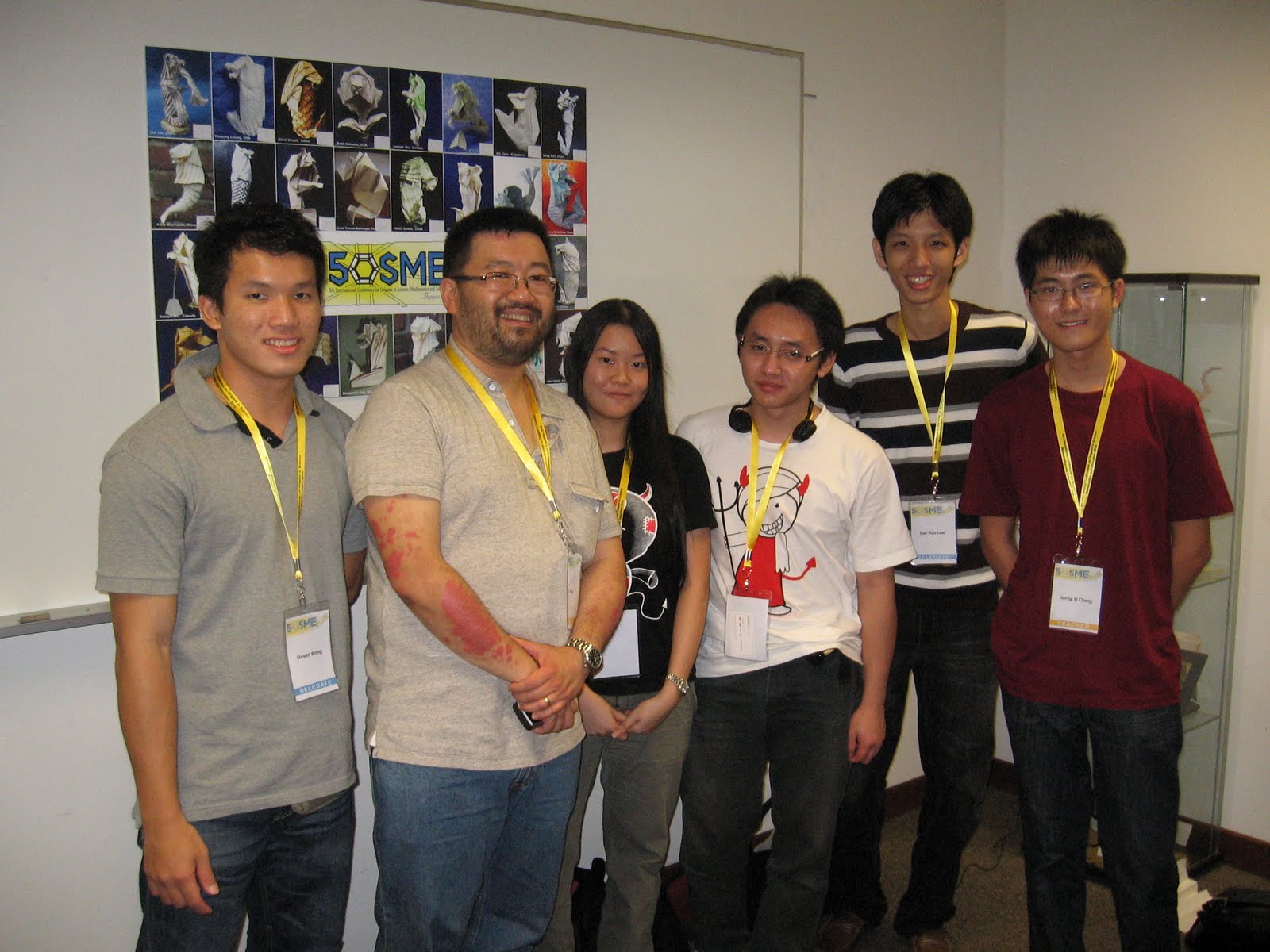
The start of the convention! I finally met the rest of the NUS High students who would be attending the convention, and I directed them to the exhibition. I also saw Steven Wong, a Malaysian origamist who I got to know through his blog and chatted over MSN for a few years who brought 3 friends over from Malaysia to attend the convention. Here's a picture of he and his friends + Joseph Wu + me:
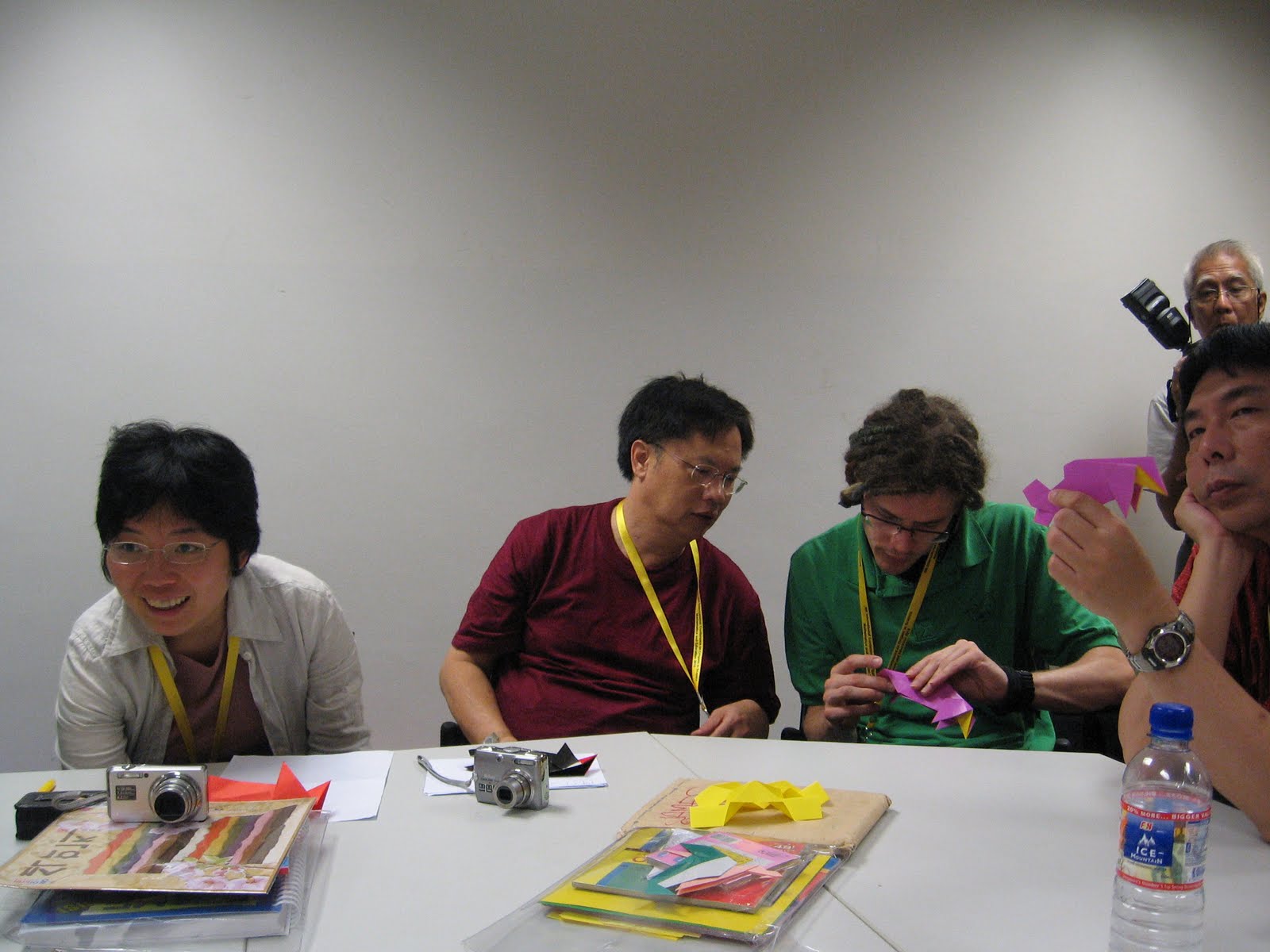
I then got the diagrams for Jason Ku's fairy and followed them until 10 am, when the classes started. I went to Joseph Wu's class, where he taught us how to fold a Salmon.
The people who I know in the photo are (from left) Winnie from Australia, Curtis Choy from Singapore, James Peake, Koichi Tateishi and Chan Yew Meng. Koichi is rather proficient at English and is currently in the process of translating many books, including one by Eric Joisel and another by Kamiya Satoshi. Yew Meng is from Origami Singapore, and he is in charge of taking lots of photos and giving the photos to us eventually in a disc.
The salmon took the whole of the morning, and I had lunch with some of the Origami Singapore people, Robert Lang and Jason Ku. The last two shared 4 (?) fried dumplings, 2 huge meat buns and some siew mai, strangest lunch I've seen. Robert and I discussed a bit about Tomohiro Tachi's rigid-foldable thick origami, and I also suggested that since 6OSME would be held in Japan, it should be held near the location and date of the annual Origami Tanteidan convention so conference attendees could get more out of their trip to Japan by going to both.
The Demaines returned from their lunch with Cheng Chit, and somehow they, together with Aviv, Jason, Tachi and I ended up in one of the unlocked rooms and started a "brainstorming session". Strangely, Robert popped in for a bit and got a piece of paper, but I didn't pay much attention to what he was doing and he left later. Since much of our work was similar or related, we were thinking of how we could combine our ideas and generalize them. Quite a few possible generalizations were suggested, and the session which lasted so long that I skipped all my afternoon workshops ended satisfactorily. We agreed to continue to keep in touch through a mailing list so we can send each other ideas.
Another very interesting thing that happened that day was when Jason decided to have dinner with Robert Lang and the Demaines at an Indian restaurant. I decided to join him, and by the time we got there about 20 other people had decided to join us too :) We sat along 7-8 tables connected in a long chain and I had the best meal in my life. Let's talk about the food first:
- Large loveletter-shaped crispy biscuits (???) with slightly spicy tomato puree and mint spices (?)
- Salad + a huge prawn + some fish + a big button mushroom stuffed with potatos and spices
- Warm and crispy Naan bread with fish curry, chicken curry, lentil curry, curry potatoes, saffron rice, some mushroom puree thing and an antidote for spiciness.
- Watermelon and ginger juice
- Mango-flavoured ice cream
Items 2 and 4
Item 3
Everything was just soooo nice and just at my threshold for spiciness, so I really enjoyed the meal, I ate like 4 of the Naan bread stuffed with the various fillings provided.
The conversation was also great; to my right, Joseph, Tachi and Andrew Hudson were discussing about how bad some professors could be at teaching, and there was a quite lengthy discussion between Joseph and Tachi about Japanese politics. Joseph also mentions
molecular gastronomists, who are culinary artists who experiment with chemicals to create artificial tastes. Apparently, their food is expensive but tastes very, very nice. An example is a tiny cube of gelatin served a huge platter; when you rest the cube on your tongue, you experience the taste of pizza.
Martin also came over to tell us about a few among his collection of the ways MIT students get free meals (nothing too honorable ^_^) and how to make people think one is smart in MIT (e.g. walk casually past a room and glance at the whiteboard, then remark that there's a small mistake but it won't be much of a problem and leave).
Since Erik and Martin were leaving Singapore early the next morning, we bid them farewell at the end of the dinner; I meant it when I told Erik that our meeting had gone better than anything I'd hoped for, especially the brainstorming session. What a great dinner, I felt so much closer to everyone in that room after it!
Day 5: Saturday, 17 July, SMU School of Business
I arrived at 8.30 am, and Boon told me to leave my bags in Kamiya Satoshi's class 1.5 hours early to reserve places. I'm glad I followed his advice, because by 9 am almost all of the seats were taken. I folded the box (see the previous post) that I would be teaching later in the afternoon to prepare for the workshop and while away time.
The class was really packed full by the time Kamiya entered, and he distributed the diagrams for his Raccoon Dog (or "Tanuki" would be more familiar to those who watch anime). It was fairly complicated, but I was able to finish it and shape it to my content. Jason and Wil Chua popped in to take the diagrams and paper too.

Lunch was at the hawker center downstairs, and I met up with all the NUS High students who came and we watched Between the Folds together. I'm glad that everyone in the room paid attention and didn't scoff at the slow-paced moments :) After the documentary, a Singaporean teacher asked if I could teach my Simple Box early; I agreed, and a few NUS High students joined in too. I told them that ironically, the inspiration for the box came from a japanese book on modular boxes written by Tomoko Fuse, and when I went to the National Library to search for Advanced Origami, I flipped open a book titled "The Origami Artist's Bible" out of curiosity and I saw the diagrams for an identical box, created by Tomoko Fuse. The rest of the day wasn't that interesting, I said my farewells and left 5OSME, and I got Aviv's MSN contact so we can still keep in touch.
I can't wait for 6OSME in Japan!!! I love this community, and I'm very grateful that I seem to have been accepted into it. The dinner really bonded me to them, and i love their easygoing attitude and crazy antics (Conference Banquet). Of course, I look forward to working with Erik, Martin, Aviv, Jason and Tachi!
Too bad Thomas Hull wasn't here, I wanted to ask him how origami is related to abstract algebra :)

Origami as
Pure as Snow
Shonen